


What Is a Critical Point? Definition, How to Find It & Calculator
Quick Answer
A critical point is any x-value inside the domain of the function where the first derivative equals zero — or does not exist. These points show you where a function reaches a local maximum, a local minimum, or changes behavior. They are the starting point for every optimization problem in calculus.
Table of Contents
- What Makes a Point "Critical"?
- The First Derivative Test
- How to Find Critical Points: 5-Step Method
- How to Classify: Maximum, Minimum, or Saddle Point?
- Three Worked Examples
- Critical Points Calculator
- Critical Points vs. Inflection Points
- Real-World Uses
1. What Makes a Point "Critical"?
In math, "critical" has one specific meaning. It does not just mean "important."
Definition
A number c inside the domain of the function f is a critical number when:
- The derivative equals zero: f′(c) = 0
- The derivative of the function does not exist: f′(c) is undefined
The coordinate pair (c, f(c)) on the curve is the critical point of the function.
Many students only learn the first rule — set the derivative to zero and solve. This causes them to miss critical points that appear at sharp corners, cusps, and vertical tangents. Both rules matter equally.
Why This Definition Makes Sense
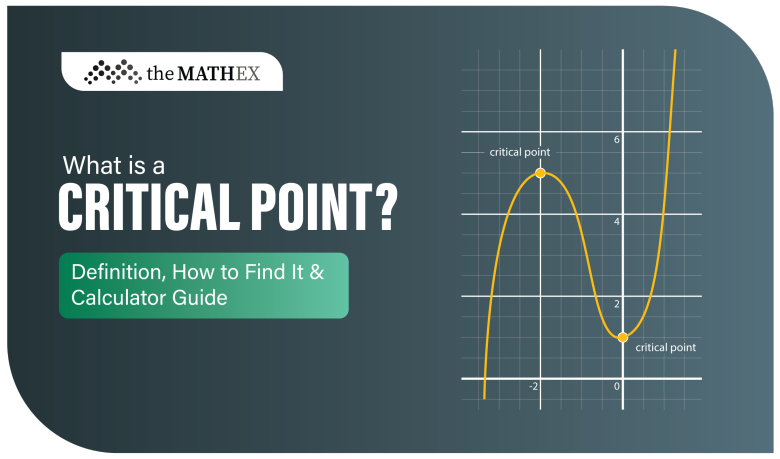
When f′(c) = 0, the tangent to the graph of the function is flat. The function has stopped rising or falling. This creates a peak, a valley, or a level stretch.
When f′(c) is undefined, the curve has a sharp turn — like the tip of the absolute value function — or a vertical tangent. At both spots, the function can still have a highest or lowest value nearby.
Important note:
Not every critical point is a local maximum or local minimum. Some points of a function are neither. The function may pause, then keep going in the same direction. This is why classifying each point matters.
| ConditionShape on GraphCould Be | ||
| f′(c) = 0 | Flat tangent line | Local max, min, or neither |
| f′(c) undefined | Sharp corner | Local max, min, or neither |
2. The First Derivative Test
The derivative test tells you what type of point you found. It reads the sign of f′(x) on each side of the critical number.
A function rises where its derivative is positive. It falls where its derivative is negative.
So:
- If f′ goes from positive → negative through c, the function peaked. That point is a local maximum.
- If f′ goes from negative → positive, the function bottomed out. That point is a local minimum.
- If f′ keeps the same sign on both sides, the point is neither.
This shift from decreasing to increasing — or the reverse — is the key signal.
| f′ Left of cf′ Right of cResult | ||
| Positive | Negative | Local Maximum |
| Negative | Positive | Local Minimum |
| Positive | Positive | Neither |
| Negative | Negative | Neither |
This test works every time. Use it when other methods fail.
3. How to Find Critical Points: 5-Step Method
Use these five steps to find the critical numbers of any function. Follow them in order every time.
Step 1 — Find f′(x)
Take the derivative of the function.
Use the right rule:
- power rule
- product rule
- quotient rule
- chain rule
Any error here will affect every step that follows.
Step 2 — Set f′(x) = 0 and Solve
Set the derivative equal to zero and solve for x.
This is how you calculate critical points from flat-tangent locations.
You may need to:
- factor
- use the quadratic formula
- apply trig identities
Each solution is a candidate.
Step 3 — Find Where f′(x) Is Undefined
Look for x-values that make the derivative undefined, like a zero in a fraction's denominator.
Also check for:
- negative values under square roots
- division by zero
- cusps and corners
Write down every such value.
Step 4 — Check the Domain of the Function
This step saves you from a very common error.
Each candidate from Steps 2 and 3 must actually be inside the domain of the function.
If f(c) is undefined, then c is not a critical number — even if f′(c) = 0 or breaks down there.
Step 5 — Compute (c, f(c))
Plug each valid critical number into the original function.
Find the y-coordinate.
The full ordered pair is the critical point.
4. Classifying: Maximum, Minimum, or Saddle Point?
Once you have your critical numbers, you need to identify each type of critical point.
Method A — First Derivative Test (Sign Chart)
This method always works.
Build a sign chart:
- Place all critical numbers on a number line.
- Pick a test value in each interval.
- Check the sign of f′ at each test value.
- Use the sign-change table.
When the sign shifts:
- negative → positive = local minimum
- positive → negative = local maximum
- no sign change = neither
Method B — Second Derivative Test
This method is faster when it works.
At a critical number c where:
f′(c) = 0
check the second derivative.
| f″(c)Curve ShapeResult | ||
| f″(c) > 0 | Concave up | Local Minimum |
| f″(c) < 0 | Concave down | Local Maximum |
| f″(c) = 0 | No conclusion | Use first derivative test |
theMathex Tip:
The second derivative test fails when f″(c) = 0.
Always keep the first derivative test as your backup.
What About Saddle Points?
A saddle point belongs to multivariable calculus.
A point can be:
- minimum in one direction
- maximum in another direction
To find these:
- all partial derivatives must equal zero
In single-variable calculus, when a point is neither a max nor a min, you simply call it "neither."
5. Three Worked Examples
Example 1 — Polynomial Function
Function:
f(x) = x^3 − 3x^2 − 9x + 5
Step 1 — Find the derivative
f′(x) = 3x^2 − 6x − 9
Step 2 — Set derivative equal to zero
3x^2 − 6x − 9 = 0
Factor:
3(x − 3)(x + 1) = 0
Critical numbers:
x = 3
x = −1
Step 3 — Check where derivative is undefined
The derivative is a polynomial, so it exists everywhere.
Step 4 — Check the domain
The function exists for all real numbers.
Both values are valid.
Step 5 — Find the critical points
f(3) = −22
Critical point:
(3, −22)
f(−1) = 10
Critical point:
(−1, 10)
Sign Chart
| IntervalTest ValueSign of f′Behavior | |||
| x < −1 | x = −2 | Positive | Rising |
| −1 < x < 3 | x = 0 | Negative | Falling |
| x > 3 | x = 4 | Positive | Rising |
Results:
- x = −1 → local maximum
- x = 3 → local minimum
Example 2 — Trigonometric Function
Function:
f(x) = 2sin(x) − x
on interval:
[0, 2π]
Step 1 — Find the derivative
f′(x) = 2cos(x) − 1
Step 2 — Set derivative equal to zero
2cos(x) − 1 = 0
cos(x) = 1/2
Solutions:
x = π/3
x = 5π/3
Step 3 — Check where derivative is undefined
Derivative exists everywhere.
Step 4 — Check the interval
Both values lie inside [0, 2π].
Step 5 — Find the critical points
f(π/3) ≈ 0.685
Critical point:
(π/3, 0.685)
f(5π/3) ≈ −6.968
Critical point:
(5π/3, −6.968)
Second Derivative Test
f″(x) = −2sin(x)
At x = π/3:
f″(π/3) < 0
→ Local Maximum
At x = 5π/3:
f″(5π/3) > 0
→ Local Minimum
Example 3 — Rational Function
Function:
f(x) = (x^2 − 4) / (x − 1)
Step 1 — Find the derivative
f′(x) = (x^2 − 2x + 4) / (x − 1)^2
Step 2 — Set numerator equal to zero
x^2 − 2x + 4 = 0
Discriminant:
b^2 − 4ac
= (−2)^2 − 4(1)(4)
= 4 − 16
= −12
Since the discriminant is negative:
No real solutions.
Step 3 — Check where derivative is undefined
Derivative undefined at:
x = 1
Step 4 — Check the domain
Original function is also undefined at x = 1.
Therefore:
x = 1 is NOT a critical point.
Final Result
This function has no critical points.
Key lesson:
A break in the derivative does not create a critical point.
Always check the domain first.
6. Critical Points Calculator
Want to verify your answers fast?
The theMathex Critical Points Calculator handles:
- derivatives
- solving equations
- classification
- graph analysis
How to use it:
- Enter your function
- Set interval if needed
- Click "Calculate"
- Read the results and graph
Open the calculator:
https://www.themathex.com/critical-point-calculator
The calculator supports:
- polynomials
- trig functions
- rational functions
- logarithmic functions
- exponential functions
Use the tool to verify your work — not skip learning the process.
7. Critical Points vs. Inflection Points
These concepts are different.
| Critical PointInflection Point | |
| Based on first derivative | Based on second derivative |
| f′(c) = 0 or undefined | f″(c) = 0 with concavity change |
| Flat tangent or corner | Curve changes bending direction |
| Can be max or min | Usually not max or min |
Example:
f(x) = x^3
At x = 0:
- f′(0) = 0
- concavity changes
So:
x = 0 is BOTH:
- critical point
- inflection point
But it is neither a local maximum nor local minimum.
8. Real-World Uses
Business — Profit Maximization
Suppose:
P(x) = −2x^2 + 800x − 5000
Set derivative equal to zero.
The critical point gives the production level that creates maximum profit.
Engineering — Minimum Material
Critical points help engineers minimize:
- material usage
- surface area
- energy cost
Example:
finding the cylinder radius that uses least material.
Physics — Maximum Height
Projectile equation:
h(t) = −16t^2 + 96t + 10
Set derivative equal to zero.
The critical point gives the highest point of the object.
Machine Learning — Loss Functions
Deep learning models minimize loss functions using gradient descent.
The minimum value occurs at a critical point.
This is one of the most important optimization concepts in AI.
Key Takeaways
- A critical point occurs where f′(c) = 0 or undefined, while f(c) exists.
- Always check the domain before accepting a critical number.
- Use the first derivative test to classify points.
- Critical points and inflection points are different ideas.
- Multivariable functions use partial derivatives to locate saddle points.
Practice Problems
- Determine all critical points for:
f(x) = x^4 − 8x^2
- Find and classify all critical points of:
f(x) = sin^2(x)
on interval:
[0, π]
- Does:
f(x) = |x − 3|
have a critical point?
Explain why.
- A farmer has 200 meters of fencing.
What rectangle dimensions maximize area?
Write area as a function of one variable and calculate the critical points.
Found an error? Email: [email protected]