


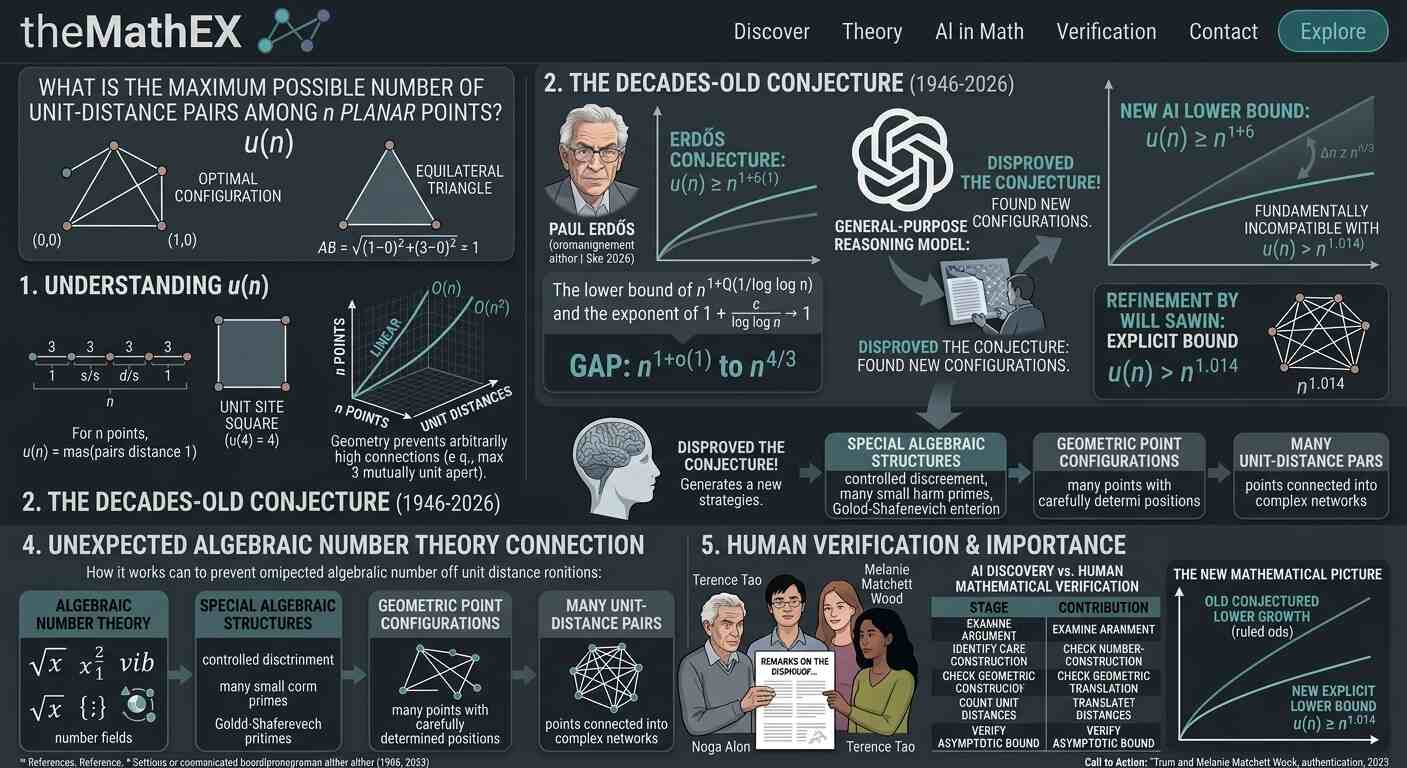
What Is the Erdős Unit-Distance Problem?
Let's start with the basic idea.
Imagine placing n points anywhere in the two-dimensional plane.
Take two points and calculate their Euclidean distance. If that distance is exactly 11, we call the pair a unit-distance pair.
For example, consider
A=(0,0)
and
B=(1,0).
Their distance is
\[|AB| = \sqrt{(1-0)^2 + (0-0)^2} = 1.\]
Therefore, A and B form a unit-distance pair.
Now imagine that instead of two points, we have n points. Some pairs will be exactly one unit apart and others will not.
The fundamental question is:
\(\boxed{\text{What is the maximum possible number of unit-distance pairs among }n\text{ points?}}\)
Mathematicians denote this maximum by
u(n).u(n).
Thus,
u(n)=max{number of unit-distance pairs among n planar points}.u(n)=\(\max\)\{\(\text{number of unit-distance pairs among }\)\(n\text{ planar points}\)\}.
That is the Erdős unit-distance problem.
A Simple Example
Suppose we place points on a straight line:
\[0,\;1,\;2,\;3,\;4\]
There are four adjacent pairs separated by exactly one unit:
\[(0,1),\;(1,2),\;(2,3),\;(3,4)\]
So five points can give at least four unit-distance pairs.
But a line isn't the best way to arrange points.
A square is already more interesting.

A square has four vertices and every edge has the same length. If we scale the square so that its sides have length 11, it produces four unit-distance pairs.
With larger square grids, the number of unit-distance pairs grows substantially.
This led mathematicians to search for increasingly sophisticated configurations.
The Mathematical Question Behind the Problem
The interesting part isn't finding some unit distances.
It is finding the maximum possible number.
For n points there are
\[\binom{n}{2} = \frac{n(n-1)}{2}\]
possible pairs.
If every pair could be exactly one unit apart, we would have approximately n^2/2 unit distances.
But geometry prevents that.
For example, in the plane, you cannot have arbitrarily many points where every pair is exactly distance 1. At most three points can be mutually separated by distance 1: they form an equilateral triangle.
So the real question is somewhere between linear and quadratic growth.
For decades, mathematicians did not know the exact asymptotic behavior of
u(n).
What Did Erdős Conjecture?
Erdős constructed configurations that produced more than a linear number of unit distances.
His construction gives a lower bound of roughly
\[u(n)\geq n^{1+\Omega(1/\log\log n)}.\]
The important feature here is the exponent.
The expression
\[1+\frac{C}{\log\log n}\]
approaches 1 as n becomes very large.
So although the construction beats a simple linear bound, it does so by an increasingly small amount in the exponent.
For decades, mathematicians believed that this was essentially the best possible behavior.
Erdős conjectured the upper bound
\[\boxed{u(n)\leq n^{1+o(1)}}.\]
The notation o(1) means a quantity that approaches zero as n approaches infinity.
Informally, Erdős was conjecturing:
The number of unit distances can grow faster than linearly, but not by a fixed power of n.
That conjecture survived for nearly eight decades.
Why Was the Problem So Difficult?
At first glance, the problem looks like elementary geometry.
That is misleading.
There were several reasons it resisted a solution.
1. The problem is about arbitrarily large configurations
You might be able to find the best arrangement for
n=5,
or perhaps even
n=100.
But proving an asymptotic statement means understanding what happens as
\[n\rightarrow\infty.\]
A computer search over small configurations cannot establish the general result.
2. Finding examples is easier than proving optimality
Suppose someone gives you a configuration containing one million unit-distance pairs.
That proves only
\[u(n)\geq 1,000,000.\]
It doesn't tell you whether another configuration might contain two million.
To solve the problem, mathematicians need either:
- a construction showing many unit distances, and
- an upper bound proving that substantially more are impossible,
or a construction that directly contradicts the proposed upper bound.
That distinction made the Erdős problem particularly challenging.
3. The known upper and lower bounds were far apart
Before the 2026 breakthrough, the best general upper bound was essentially
u(n)=O(n^{4/3}),
a result originating with Spencer, Szemerédi and Trotter in 1984.
Meanwhile, the Erdős construction was approximately
\[n^{1+\Omega(1/\log\log n)}.\]
So mathematicians had a gap between roughly
\[n^{1+o(1)}\]
and
\[n^{\frac{4}{3}}.\]
Closing that gap was extraordinarily difficult.
The Unexpected AI Breakthrough
In 2026, OpenAI evaluated an internal general-purpose reasoning model on a collection of Erdős problems.
The model was not specifically trained to solve the unit-distance problem, according to OpenAI's account. It was not simply running a specialized unit-distance algorithm.
Instead, it generated a proof strategy that produced an entirely new family of configurations.
And the surprising part was this:
The AI did not prove Erdős's conjecture.
It disproved it.
The model found configurations containing substantially more unit-distance pairs than the conjecture permitted.
More precisely, the construction establishes that for infinitely many nn,
\[\boxed{u(n)\geq n^{1+\delta}}\]
for some fixed
\[\delta>0.\]
That is fundamentally incompatible with
\[u(n)\leq n^{1+o(1)}.\]
Therefore, Erdős's conjecture is false.
How Much Better Is the New Construction?
The original AI proof established the existence of a fixed positive exponent δ\(\delta\), but did not make the value explicit.
A subsequent refinement by Princeton mathematician Will Sawin made the improvement quantitative.
Sawin showed that one can take
\[\boxed{\delta=0.014}.\]
Thus, for arbitrarily large nn, there are configurations with more than
\[\boxed{n^{1.014}}\]
unit-distance pairs.
This is an important improvement because the exponent is now explicit rather than merely known to be greater than 11.
The Most Surprising Part: Algebraic Number Theory
Perhaps the most fascinating aspect of the solution is where the key ideas came from.
The original problem is geometric.
You have:
- points,
- distances,
- planes,
- grids.
Yet the successful construction relies on ideas from algebraic number theory.
Algebraic number theory studies mathematical objects such as algebraic number fields, ideals, discriminants and prime splitting.
These objects may seem completely unrelated to distances between points.
But the AI discovered a way to connect them.
OpenAI's report says the proof uses sophisticated ideas from algebraic number theory to construct configurations with many unit distances.
The human-verified companion paper notes connections to ideas associated with Ellenberg–Venkatesh, Golod–Shafarevich, and Hajir–Maire–Ramakrishna.
This is one of the most interesting aspects of the discovery.
The breakthrough was not simply:
"Try a better grid."
It was essentially:
Use a number-theoretic construction to manufacture a geometric configuration with an unexpectedly high number of repeated distances.
How Does the Number-Theoretic Construction Help?
The detailed proof is highly technical, but the underlying strategy can be described conceptually.
The construction uses algebraic number fields with carefully controlled properties.
One important ingredient is finding number fields with:
- sufficiently large degree,
- controlled discriminant,
- and many primes with relatively small norms.
Sawin's explicit version describes a number-theoretic construction involving algebraic number fields of large degree and small discriminant, together with many primes of small norm, using a Golod–Shafarevich criterion.
Those number-theoretic structures can then be transformed into geometric configurations.
The resulting points have an unusually large number of pairs whose Euclidean distance is exactly 11.
So the chain is roughly:
Algebraic number theory
\[\text{Algebraic number theory}\]
\[\;\downarrow\;\]
\[\text{special algebraic structures}\]
\[\;\downarrow\;\]
\[\text{geometric point configurations}\]
\[\;\downarrow\;\]
\[\text{many unit-distance pairs}\]
This connection was one of the reasons the result was so unexpected.
Did AI Actually "Solve" the Problem?
This requires some nuance.
Yes—in the sense that the AI generated the key mathematical argument that disproved the conjecture.
OpenAI describes this as the first time one of its models autonomously solved a prominent open problem central to a mathematical subfield.
But saying "AI solved mathematics" can be misleading if it suggests that nobody checked the result.
The proof went through human mathematical scrutiny.
That distinction is extremely important.
How Did Humans Verify the AI's Proof?
After the model produced its argument, a group of external mathematicians examined it.
They included researchers such as:
- Noga Alon
- Thomas Bloom
- W. T. Gowers
- Daniel Litt
- Will Sawin
- Arul Shankar
- Jacob Tsimerman
- Victor Wang
- Melanie Matchett Wood
They produced a human-written paper titled:
"Remarks on the disproof of the unit distance conjecture."
The paper presents a shorter, digested version of the AI-generated counterexample and explains the mathematical ideas behind it.
This is crucial because an AI-generated proof isn't automatically accepted as correct simply because the model produces convincing-looking mathematical text.
Mathematical correctness requires that every logical step actually follows.
The Human Verification Process
The verification can be understood in several stages.
Step 1: Examine the AI's argument
Mathematicians first had to determine what the model was actually claiming.
This is particularly important for a long AI-generated proof because mathematical language models can sometimes produce plausible but invalid arguments.
Step 2: Identify the core mathematical construction
The researchers extracted the underlying mathematical idea rather than treating the AI's original presentation as authoritative.
Step 3: Check the number-theoretic ingredients
They examined whether the required algebraic number fields and prime-related properties actually exist.
Step 4: Check the geometric translation
The next question was whether the number-theoretic objects really generate the claimed point configuration.
Step 5: Count the unit distances
The resulting configuration must genuinely contain sufficiently many distinct pairs satisfying
|P_i-P_j|=1.
Step 6: Verify the asymptotic bound
Finally, the researchers checked that the number of unit-distance pairs grows as
\[n^{1+\delta}\]
for a fixed positive \(\delta\).
Once that was established, the Erdős conjecture
\[u(n)\leq n^{1+o(1)}\]
could no longer hold.
Why Human Verification Matters
Consider an AI saying:
2+2=5.
It doesn't matter how sophisticated the explanation sounds. The statement is false.
Mathematics is different from many other forms of AI-generated content because the claims can ultimately be checked against formal logical requirements.
For the Erdős problem, the verification was especially important because this was a new mathematical result, rather than a standard theorem already known to researchers.
The external mathematicians did not simply say:
"The AI seems convincing."
They developed a human-readable mathematical account of the construction and its implications.
That gives the result substantially stronger mathematical grounding.
AI Discovery vs. Human Mathematical Verification
This episode therefore represents an interesting division of labor.
| Stage | Contribution |
| Problem selection | Humans |
| Exploration | AI |
| Discovery of construction | AI |
| Initial proof | AI |
| Mathematical interpretation | Humans + AI |
| Independent checking | Human mathematicians |
| Explicit exponent 0.0140.014 | Will Sawin |
| Human-readable mathematical exposition | Mathematicians |
This distinction is important.
The AI was responsible for the original breakthrough, while mathematicians were responsible for understanding, checking, refining and communicating it.
What Changed After the Discovery?
Before the result, the prevailing conjecture was approximately
\[u(n)\leq n^{1+o(1)}.\]
The AI-generated construction instead establishes
\[u(n)\geq n^{1+\delta}\]
for a fixed
\[\delta>0.\]
Sawin's refinement gives
\[\boxed{u(n)>n^{1.014}}\]
for arbitrarily large nn.
So the mathematical picture changed from:
\[n1+o(1)≲u(n)≲n4/3n^{1+o(1)} \lesssim u(n) \lesssim n^{4/3}\]
to a situation in which the old conjectured lower-growth behavior is definitively ruled out.
The exact asymptotic behavior of u(n) remains an important mathematical question.
In other words, disproving Erdős's conjecture does not mean that the unit-distance problem is completely solved.
It means that one of the central beliefs about its answer has been shown to be false.
Why This AI Result Is Important
The significance goes beyond unit distances.
The problem had several characteristics that make it a particularly meaningful test for AI mathematical reasoning:
- It was genuinely open.
- It had resisted mathematicians for decades.
- The problem was easy to state but technically deep.
- The successful construction came from an unexpected area of mathematics.
- The AI generated a new mathematical idea rather than merely retrieving a known theorem.
- Human mathematicians independently examined and explained the result.
OpenAI describes the result as a milestone because it demonstrates that advanced reasoning models can potentially contribute to frontier mathematical research rather than merely solve exercises whose answers are already known.
AI Did Not Replace Mathematicians
Perhaps the most accurate way to describe what happened is not:
"AI solved mathematics and humans checked it."
A better description is:
"AI discovered a new mathematical construction, and mathematicians independently verified, refined and contextualized the result."
That distinction matters.
The AI found the unexpected path.
The mathematicians established that the path actually works.
And Sawin subsequently strengthened the result by obtaining the explicit exponent
\[\delta=0.014.\]
This is a useful model for how AI could participate in mathematical research: machine-generated exploration combined with rigorous human verification.
Conclusion
The Erdős unit-distance problem began with an elementary question:
How many pairs of n points can be exactly one unit apart?
\(\boxed{\text{How many pairs of }n\text{ points can be exactly one unit apart?}}\)
Paul Erdős posed the problem in 1946, and for almost 80 years mathematicians believed that the maximum number of unit distances was essentially close to
n^{1+o(1)}.
In 2026, an OpenAI reasoning model produced a new construction that contradicted this belief.
The construction gives, for infinitely many ,
\[u(n)\geq n^{1+\delta},\]
with a later refinement establishing
\[\boxed{u(n)>n^{1.014}}.\]
The remarkable part is that the construction does not come from simply improving traditional geometric grids. Its key ingredients come from algebraic number theory.
Most importantly, the result did not remain an unverified AI claim. A group of mathematicians produced a human-verified mathematical treatment of the counterexample, providing independent scrutiny and a clearer explanation of why the construction works.
So the real story of the Erdős unit-distance problem is not simply "AI solved an 80-year-old problem."
It is more interesting:
An AI system found a mathematical construction that humans had not previously discovered, that construction overturned an 80-year-old conjecture, and mathematicians then verified and refined the result.
And the original question remains open in a new form: if n^{1+o(1)} is not the right answer, what is the true asymptotic growth of u(n)?
That may be the next chapter of the Erdős unit-distance problem.