

Euclidean vs. Non-Euclidean Geometry: The Complete Guide
For over two thousand years, one man's rulebook defined how humans understood space. Then, in the 19th century, mathematicians broke that rulebook on purpose — and discovered entire new geometries hiding inside the ones they broke. That split is the story of Euclidean geometry and non-Euclidean geometry, and understanding it changes how you see everything from a soccer ball to the fabric of the universe.
This guide walks through both systems in plain language: what they are, how they differ, and where you actually encounter them in daily life.
What Is Euclidean Geometry?
Euclidean geometry is the geometry of flat space — the kind taught in nearly every school on Earth. It's named after the Greek mathematician Euclid of Alexandria, who compiled its rules around 300 BCE in a book called Elements, one of the most influential mathematics texts ever written.
In simple terms, Euclidean geometry describes how points, lines, angles, and shapes behave on a flat, two-dimensional plane or in ordinary three-dimensional space — the kind of space you'd sketch on a piece of paper or measure with a ruler. This is the foundation of what most people mean when they say "euclidean math."
The Five Postulates (Axioms) of Euclidean Geometry
Euclid built his entire system on five simple assumptions, or postulates, that he considered self-evidently true:
- A straight line can be drawn between any two points.
- Any straight line segment can be extended indefinitely in a straight line.
- A circle can be drawn with any center and any radius.
- All right angles are equal to one another.
- The Parallel Postulate: If a line crosses two other lines and the interior angles on one side add up to less than two right angles, those two lines will eventually meet on that side.
The first four postulates felt obvious to mathematicians for centuries. The fifth one — the parallel postulate — did not. It's more complicated than the others, and mathematicians spent nearly 2,000 years trying to prove it followed logically from the first four. They never succeeded, and that failure is exactly what opened the door to non-Euclidean geometry.
Examples of Euclidean Geometry in Everyday Life
Euclidean geometry isn't abstract — it's the geometry you use constantly, often without noticing:
- Architecture and construction: floor plans, room angles, and building frames all assume flat, Euclidean space.
- Triangles always sum to 180°: true for any triangle drawn on a flat surface, which is why carpentry, surveying, and engineering rely on it.
- The Pythagorean theorem: a direct consequence of Euclid's postulates, and the basis for tools like a geometric mean calculator, since the geometric mean of a right triangle's altitude comes straight from Euclidean proofs.
- Triangle centers, like the orthocenter, only behave predictably because Euclidean space is flat — you can explore this with an orthocenter calculator.
- Scaling and similarity, such as resizing a shape while keeping its proportions, follows Euclidean transformation rules you can test with a dilation calculator.
What Is Non-Euclidean Geometry?
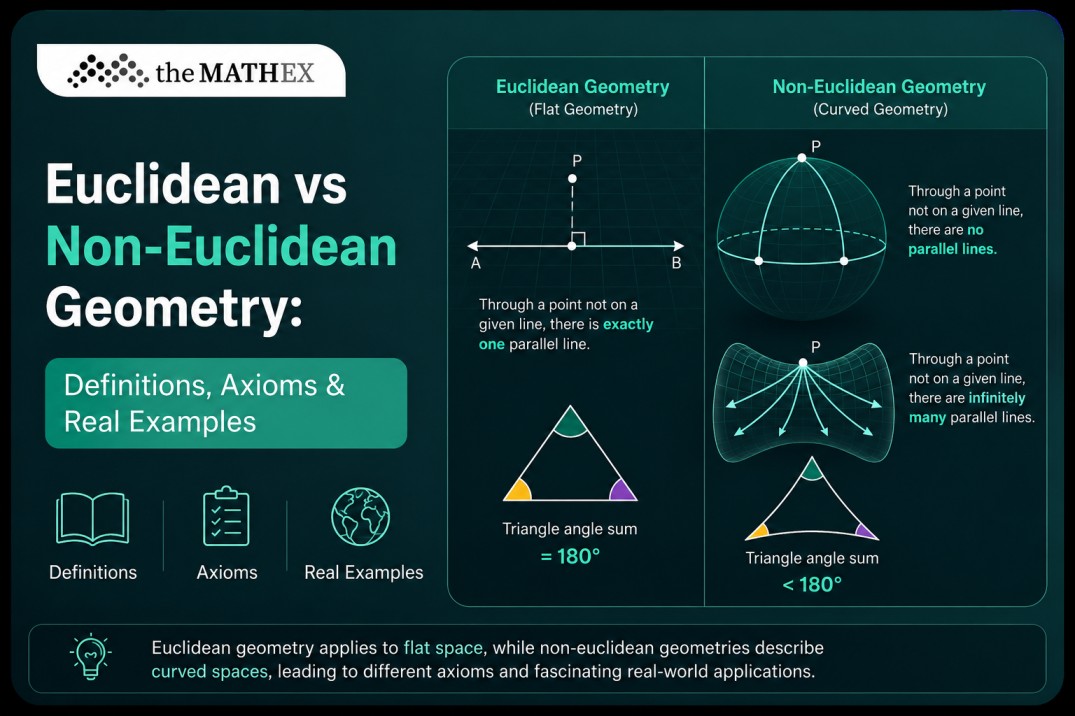
Non-Euclidean geometry is any geometric system that rejects Euclid's fifth postulate — the parallel postulate. In these systems, space itself is curved rather than flat, which changes nearly every rule you learned in school geometry.
Put simply: non-Euclidean geometry describes what happens to lines, angles, and shapes when they exist on a curved surface instead of a flat one.
A Brief History: How Non-Euclidean Geometry Was Discovered
For centuries, mathematicians tried and failed to prove Euclid's parallel postulate using the other four. In the early 1800s, several mathematicians — working mostly independently — took a different approach: what if the parallel postulate simply wasn't true? Instead of finding a contradiction, they found entirely consistent, self-contained geometries.
- Carl Friedrich Gauss privately explored curved-space geometry but never published his findings, wary of controversy.
- Nikolai Lobachevsky (Russia) and János Bolyai (Hungary) independently published the first formal descriptions of what's now called hyperbolic geometry in the 1820s–30s.
- Bernhard Riemann later generalized these ideas in the 1850s, developing the mathematics behind elliptic (spherical) geometry — work that would later become essential to Einstein's general theory of relativity.
Types of Non-Euclidean Geometry
There are two primary non-Euclidean systems, distinguished by how they curve space:
Spherical (Elliptic) Geometry
Space curves positively, like the surface of a ball. Lines become "great circles" (like the equator), triangle angles always sum to more than 180°, and there are no parallel lines at all — any two "straight" lines eventually cross.
Hyperbolic Geometry
Space curves negatively, like a saddle or a Pringle chip. Triangle angles sum to less than 180°, and instead of exactly one parallel line through a given point, there are infinitely many.
A non-Euclidean triangle, in either system, looks and behaves nothing like the flat triangles you're used to — its angles alone tell you whether the space it's drawn on is curved and in which direction.
Euclidean vs. Non-Euclidean Geometry: Key Differences
| FeatureEuclidean GeometryNon-Euclidean Geometry | ||
| Surface type | Flat plane | Curved surface (spherical or hyperbolic) |
| Parallel lines | Exactly one through a given point | None (spherical) or infinitely many (hyperbolic) |
| Triangle angle sum | Always exactly 180° | More than 180° (spherical) or less than 180° (hyperbolic) |
| Shortest path between points | A straight line | A geodesic (curved path, e.g., a great circle) |
| Common examples | Rulers, blueprints, flat-plane geometry problems | Globes, GPS systems, general relativity |
Real-World Examples of Non-Euclidean Geometry
Non-Euclidean geometry isn't just theoretical — it explains real phenomena:
- Navigation and GPS: Because Earth is a sphere, not a flat plane, long-distance flight paths and satellite calculations use spherical (elliptic) geometry, not flat-plane trigonometry.
- General relativity: Einstein used non-Euclidean (Riemannian) geometry to describe how mass curves spacetime — gravity itself is a consequence of curved, non-Euclidean space.
- Cartography: Every flat map of the round Earth introduces some distortion, precisely because you can't perfectly flatten a spherical, non-Euclidean surface onto a Euclidean plane.
Non-Euclidean Geometry in Art, Architecture, and Games
Non-Euclidean concepts have escaped pure mathematics into popular culture, which is part of why searches for "non-Euclidean architecture," "non-Euclidean art," and even "non-Euclidean Minecraft" have grown so common:
- Art: M.C. Escher's famous prints, like Circle Limit and impossible staircases, visually explore hyperbolic and paradoxical geometric spaces.
- Architecture: Buildings like Antoni Gaudí's Sagrada Família use curved, organic surfaces that echo non-Euclidean principles rather than strict flat-plane design.
- Video games: Titles and mods (including several Minecraft mods) simulate "non-Euclidean" spaces — rooms that are bigger on the inside, or hallways that loop back on themselves — by manipulating rendering rather than true curved space, but the inspiration comes directly from this branch of mathematics.
Frequently Asked Questions
What is Euclidean geometry in simple terms?
It's the geometry of flat space — the rules for points, lines, angles, and shapes that you learn in standard school geometry, based on Euclid's five postulates.
What is non-Euclidean geometry?
It's any geometry where Euclid's parallel postulate doesn't hold, describing shapes and lines on curved surfaces instead of flat ones. The two main types are spherical and hyperbolic geometry.
Who discovered non-Euclidean geometry?
Carl Friedrich Gauss, Nikolai Lobachevsky, and János Bolyai independently developed the earliest non-Euclidean systems in the early 1800s; Bernhard Riemann later expanded the field in the 1850s.
Is non-Euclidean geometry used in real life?
Yes — it's essential to GPS navigation, cartography, and Einstein's general theory of relativity, which describes gravity as curved, non-Euclidean spacetime.
What's the main difference between Euclidean and non-Euclidean geometry?
Euclidean geometry assumes flat space where triangle angles always sum to 180°. Non-Euclidean geometry describes curved space, where that sum is either more (spherical) or less (hyperbolic) than 180°.
Conclusion
Euclidean geometry gives us the predictable, flat-plane rules behind everyday measurement and design. Non-Euclidean geometry reveals what happens when space itself bends — and it turns out that curved-space math isn't a mathematical curiosity, but the actual geometry of planet Earth, GPS satellites, and the universe itself.
Want to put Euclidean geometry into practice? Try theMathex's orthocenter calculator, dilation calculator, or geometric mean calculator to explore these concepts with step-by-step solutions, or check the math formulas reference page for a full geometry formula cheat sheet.