


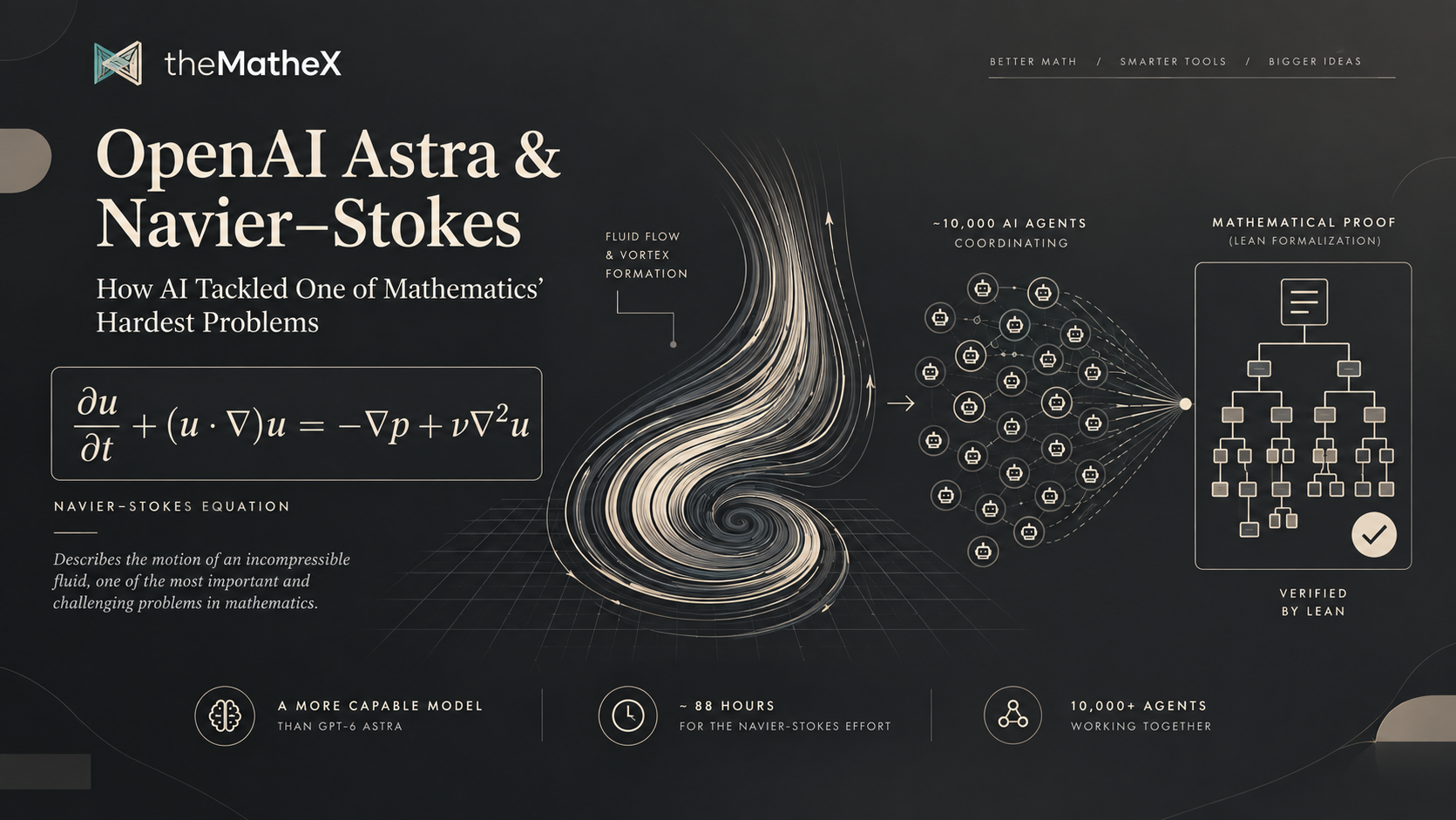
Absolutely. For the article, I would make the equation itself the center of the story, then explain in simple terms what "solving Navier–Stokes" means, followed by how OpenAI's system apparently constructed the blow-up solution and why mathematicians are scrutinizing the claim.
OpenAI Astra and the Navier–Stokes Equation: How AI Tackled One of Mathematics' Hardest Problems
The navier stokes equation is not just an abstract mathematical formula. It is one of the fundamental equations used to describe how fluids such as water and air move. It appears in problems involving weather, ocean currents, aircraft, engines, pipes, turbulence and countless other physical systems. The surprising part is that scientists have used the equation successfully for centuries of engineering and physics while mathematicians still could not completely answer one fundamental question: Can the three-dimensional Navier–Stokes equations always produce smooth, well-behaved solutions, or can the solution become singular in finite time? The Clay Mathematics Institute lists this as one of its seven Millennium Prize Problems.
Now, OpenAI says an internal AI system has produced a solution to this problem, with GPT-6 Astra playing a role in formally verifying the work. The announcement has generated enormous excitement—but also serious questions from mathematicians about exactly what has been proved and how the proof was obtained.
What Is the Navier–Stokes Equation?
To understand why the announcement is important, it helps to first understand the equation.
A simplified form of the incompressible Navier–Stokes equation is:
\[\frac{\partial \mathbf{u}}{\partial t} + (\mathbf{u}\cdot\nabla)\mathbf{u} = -\nabla p + \nu\nabla^2\mathbf{u} + \mathbf{f}\]
together with:
\[\nabla\cdot\mathbf{u}=0\]
At first glance, this may look like an ordinary physics equation. But each term describes something important about fluid motion.
Here, \(\mathbf{u}\) represents the velocity of the fluid. It tells us how quickly the fluid is moving and in which direction.
The term
\[\frac{\partial \mathbf{u}}{\partial t}\]
describes how the velocity changes with time.
The nonlinear term,
\[(\mathbf{u}\cdot\nabla)\mathbf{u}\]
describes how the movement of the fluid itself changes its velocity. This is one of the major sources of difficulty. Fluid particles are not simply moving through a fixed environment; their movement affects the surrounding flow.
The pressure term,
\[-\nabla p\]
represents the effect of differences in pressure.
The viscosity term,
\[\nu\nabla^2\mathbf{u}\]
represents the internal friction of the fluid. Water, oil, and air, for example, have different viscosities.
Finally,
\[\mathbf{f}\]
represents an external force acting on the fluid.
The second equation,
\[\nabla\cdot\mathbf{u}=0\]
essentially says that the fluid is incompressible: the amount of fluid flowing into a small region must balance the amount flowing out.
The Clay Mathematics Institute describes Navier--Stokes as the equations governing the flow of fluids such as water and air. The central mathematical difficulty is not whether we can calculate approximate fluid flows---it is whether the equations have globally well-behaved solutions under the conditions specified by the problem.
What Does It Mean to "Solve" Navier–Stokes?
This is where the recent OpenAI announcement needs careful explanation.
OpenAI did not suddenly find a formula that calculates the velocity of every fluid everywhere.
The Millennium Prize problem asks something deeper.
Suppose we start with smooth initial conditions. We want to know whether the resulting three-dimensional fluid remains mathematically smooth forever.
Imagine dropping a small disturbance into water. The equations describe how that disturbance evolves. Mathematicians want to know whether the resulting velocity, pressure and other quantities remain finite and sufficiently smooth at every later time.
One possible outcome is:
\[\text{smooth initial fluid} \rightarrow \text{smooth solution forever}\]
The other possibility is a finite-time singularity, sometimes called a blow-up:
\(\text{smooth initial fluid}\) \(\rightarrow\) \(\text{singularity in finite time}\)
In a blow-up scenario, quantities associated with the fluid's velocity or its derivatives can become unbounded.
That distinction is the heart of the Millennium Prize problem.
How Did OpenAI Approach the Problem?
According to OpenAI, the breakthrough came from a large-scale AI research effort rather than a single chatbot producing a clever answer.
Thousands of AI agents explored possible mathematical approaches in parallel. OpenAI says approximately 10,000 AI agents worked on the problem for about 88 hours. The resulting work was then formalized and checked using Lean, a proof assistant designed to verify mathematical arguments mechanically.
The crucial idea was to construct a particular fluid configuration in which the Navier–Stokes dynamics produce a finite-time singularity.
In simple terms, imagine a vortex inside a fluid. Instead of remaining nicely distributed, the flow can concentrate and stretch. Under the construction described by OpenAI, this process can become increasingly extreme until the mathematical solution breaks down.
That is fundamentally different from merely running a computer simulation.
A numerical simulation might show that a fluid appears to develop extremely high velocities. But a simulation has finite resolution. It cannot, by itself, establish that a quantity actually becomes infinite.
A mathematical proof has to establish the behavior rigorously.
That is why the formalization in Lean is such an important part of the announcement. OpenAI says it is releasing both a written proof and a formal proof in Lean.
Why Is This Such a Big Deal?
The fascinating aspect of the claimed solution is that it attacks the problem from the opposite direction to what many people might expect.
Instead of proving:
\(\text{"the solution is always smooth,"}\)
the construction aims to demonstrate:
\(\text{"there exists an allowed situation in which smoothness breaks down."}\)
If that construction satisfies all of the conditions in the Clay formulation, it is enough to establish the breakdown alternative.
This is why describing the result simply as "AI solved the Navier–Stokes equation" can be misleading. The achievement is more specific: OpenAI claims to have constructed a mathematically valid finite-time blow-up scenario satisfying the requirements of the Millennium problem.
Where Does GPT-6 Astra Fit In?
Another important detail is that Astra was not necessarily the model that independently discovered the entire proof.
OpenAI says the solution came from an internal system more powerful than its latest GPT-6 Astra model. Astra was then used to help formalize and verify the result.
This distinction matters.
The achievement is therefore better described as AI-assisted mathematical discovery and formal verification, rather than "GPT-6 Astra typed the answer to a famous equation."
The system essentially combined large-scale mathematical exploration with automated proof checking.
Why Are Mathematicians Still Skeptical?
The mathematical community's reaction has been mixed.
One major question is whether every technical condition required by the Clay problem has actually been satisfied.
Another concerns independent verification. A formal proof in Lean is powerful evidence, but mathematicians still need to examine what has been formalized, what assumptions were made and whether the formal statement exactly corresponds to the original Millennium Prize problem.
There are also questions about how much the AI system relied on existing mathematical research. OpenAI's work references previous research, including important work on Navier–Stokes and related blow-up constructions.
Some researchers have additionally raised concerns about research ethics and whether AI systems may have benefited from information contained in private interactions with mathematicians. OpenAI has denied improperly accessing unpublished research, but the controversy has added another layer to the debate.
The Real Significance of the OpenAI Result
The most important lesson may not be that AI can "do calculus."
Computers have been doing numerical mathematics for decades.
The more interesting development is that AI systems are beginning to participate in mathematical discovery: generating conjectures, searching through possible constructions, developing proofs and then translating those proofs into formally checkable mathematics.
For the navier stokes problem, that means AI has moved beyond calculating fluid behavior and into the deeper mathematical question of whether the equations themselves can develop singularities.
The result still requires scrutiny. But if the proof survives independent mathematical verification, it could represent a major milestone—not only for the navier-stokes equations, but for the role of artificial intelligence in mathematics.
The ultimate question is therefore no longer simply "Can AI solve difficult equations?"
It is becoming:
"Can AI discover new mathematics—and can humans rigorously verify what it discovers?"
And the navier-stokes equation may be one of the first major tests of that future.